

CBAM (Carbon Border Adjustment Mechanism) Does Not Start With Carbon. It Starts With a Code Nobody Checked.
Most businesses have no idea whether their goods are in scope for CBAM. Not because the rules are hidden. Because the answer lives inside a customs classification code that nobody double-checked.
We will get to the carbon in a minute. Stay with the code first, because everything else is built on top of it.
CBAM's definitive period started on 1 January 2026, quietly compared to the noise back in 2023. But quiet does not mean small. Import aluminium, cement, fertiliser, hydrogen, or iron and steel into the EU, and the mechanism has moved from asking you to report to asking you to pay. Trade into the UK, and a parallel version arrives on 1 January 2027, with its own thresholds and its own rulebook.
Two regimes. One question underneath both: is this good even in scope to begin with?
Strip away the acronym and call it what it actually is. CBAM is a tax on carbon-intensive imports. The UK version is structured as one outright, collected through an HMRC return like any other tax liability. The EU version works through certificates rather than a return, but the economics are identical: importers pay for the carbon embedded in what they bring in, or they do not get to import it. Whichever mechanism your goods sit under, the number at the end of it comes out of the same place every other tax does.
Why the code comes first
A CBAM assessment does not start with a carbon figure. It starts with a CN code, the thing that tells you whether the goods in front of you count as aluminium, cement, fertiliser, hydrogen, or iron and steel in the way CBAM means it.
Get that code wrong and you have a problem either way. Call something in scope when it is not, and you are paying verifiers for an obligation you never had. Call something out of scope when it is in, and you find out from a regulator, later than you would like.
Misclassification is not a private mistake. It is exactly what customs authorities test for in audits, and it surfaces through under or over-reporting, retrospective corrections, or delays at the border. None of those are quiet problems once they arrive.
This is the kind of problem we think about constantly, because it sits underneath most of customs compliance, not just CBAM. Classify, our HS and CN classification engine, exists precisely because this step gets rushed, guessed at, or handed to whoever has five minutes.
What changed for the EU on 1 January 2026
For two years, CBAM only asked for quarterly reports. No certificates, no money changing hands. That grace period is over. From 1 January 2026, anyone bringing CBAM goods into the EU above the 50 tonne annual threshold has to be registered as an authorised declarant before the goods move, and CBAM data now sits inside the import declaration itself.
Certificate purchases have not started yet. The first surrender deadline is 30 September 2027, covering everything imported during 2026. That gap can feel like breathing room. It is not. The exposure on this year's imports is accruing right now. The bill arrives later. The debt does not.
The UK is building its own version, on its own clock
The UK CBAM lands on 1 January 2027, covering the same five sectors. The registration threshold sits at £50,000 of CBAM goods over a rolling twelve months, tested two ways: a backward look at the last twelve months, and a forward look at the next thirty days, so one large shipment can trip it alone.
The mechanics differ from the EU's in a way that matters, not just in the numbers. The EU runs on certificates, bought and surrendered, and requires authorised declarant status before you are allowed to import a single CBAM good. The UK version is a tax, collected through an HMRC return, and it does not work that way. There is no pre-authorisation step. Liability is established through the customs declaration itself, and you register with HMRC once you cross the threshold, not before you are permitted to trade.
The UK has its own version of the quiet gap, too. The tax point starts 1 January 2027, but HMRC's registration service is not expected to open until a full year later, on 1 January 2028, with the first return and payment due 31 May 2028. There is a first-year concession: businesses that first become liable during 2027 have until 31 January 2028 to register, rather than the standard 30-day window that applies from 2028 onward. That concession covers registration. It does not touch the underlying liability, which starts accruing from day one regardless of when you get round to registering.
One more thing worth knowing, specific to the UK: the customs procedure a shipment moves under can change whether UK CBAM applies at all. Goods in customs warehousing or inward processing, then re-exported, can avoid a charge entirely. The same goods released to free circulation trigger the tax point immediately.
How iX actually helps
This part is from Ben, our co-founder, on what we are actually seeing.
Most businesses that will owe CBAM do not yet know they will. The threshold is a value test, £50,000 of CBAM goods on a rolling twelve months, not a volume one, so it catches importers whose instinct says they are far too small to be affected. A company bringing in steel fixings or aluminium extrusions does not think of itself as carbon-regulated. Commodity code 7318, screws, bolts, nuts, rivets, is squarely in scope.
The difference with iX is that we already hold the answer. Every declaration we have ever filed carries the commodity code, net mass, customs value, country of origin, and customs procedure code. That is everything the regime asks for. We do not need to send a questionnaire and wait for a spreadsheet. We can just look.
We run CBAM over the years you have already imported. Not a forecast, not a model, your actual entries, classified line by line against the published goods list. You find out today which of your goods would have been in scope, what they were worth, and where you would have sat against the £50,000 threshold, for any period you choose.
We show you the trajectory, not just the total. A rolling twelve-month position against the threshold line, plus your last thirty days as a run rate. If you are at £41,000 and climbing, you know months before it matters, not in 2028 when someone asks for records you never kept.
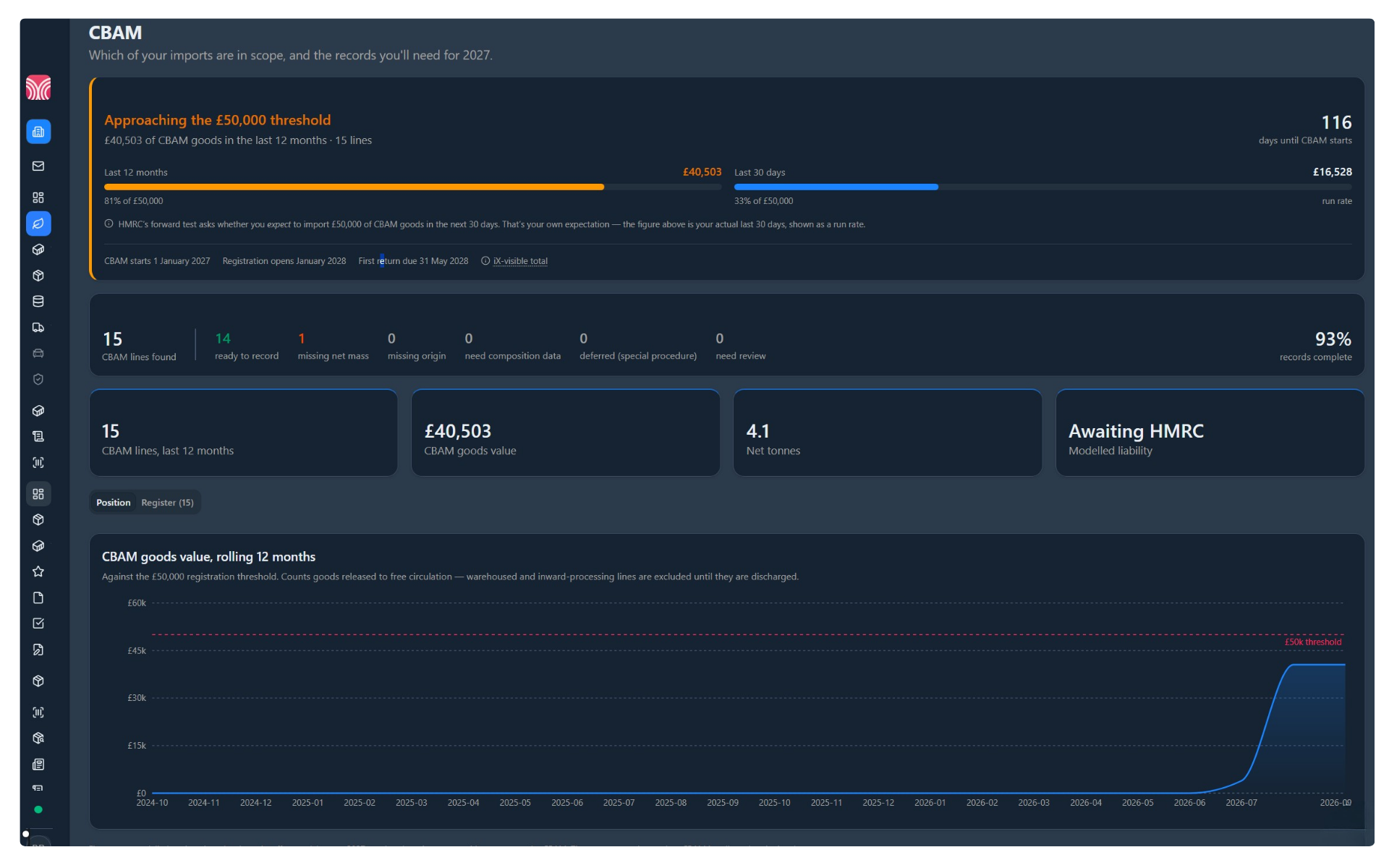
We know when goods are not liable yet. CBAM attaches on release to free circulation. Goods in a customs warehouse, under inward processing, in a freeport, or on temporary admission carry no liability until they are discharged. iX reads the procedure code on every line, so warehoused stock is marked deferred rather than wrongly counted. A carbon consultancy working from an emailed spreadsheet cannot make that distinction, because the customs procedure is not in the spreadsheet.
We flag the classification and data problems now, while they are cheap. Every in-scope line is graded: liable, deferred, needs review, or incomplete. Incomplete means it is liable but missing something a 2028 return will need, no net mass, no country of origin. Needs review means the classification genuinely cannot be resolved automatically. Those are cheap to correct on this year's entries and expensive to reconstruct in 2028. Records must be kept for six years, and failing to keep them carries a £500 penalty.
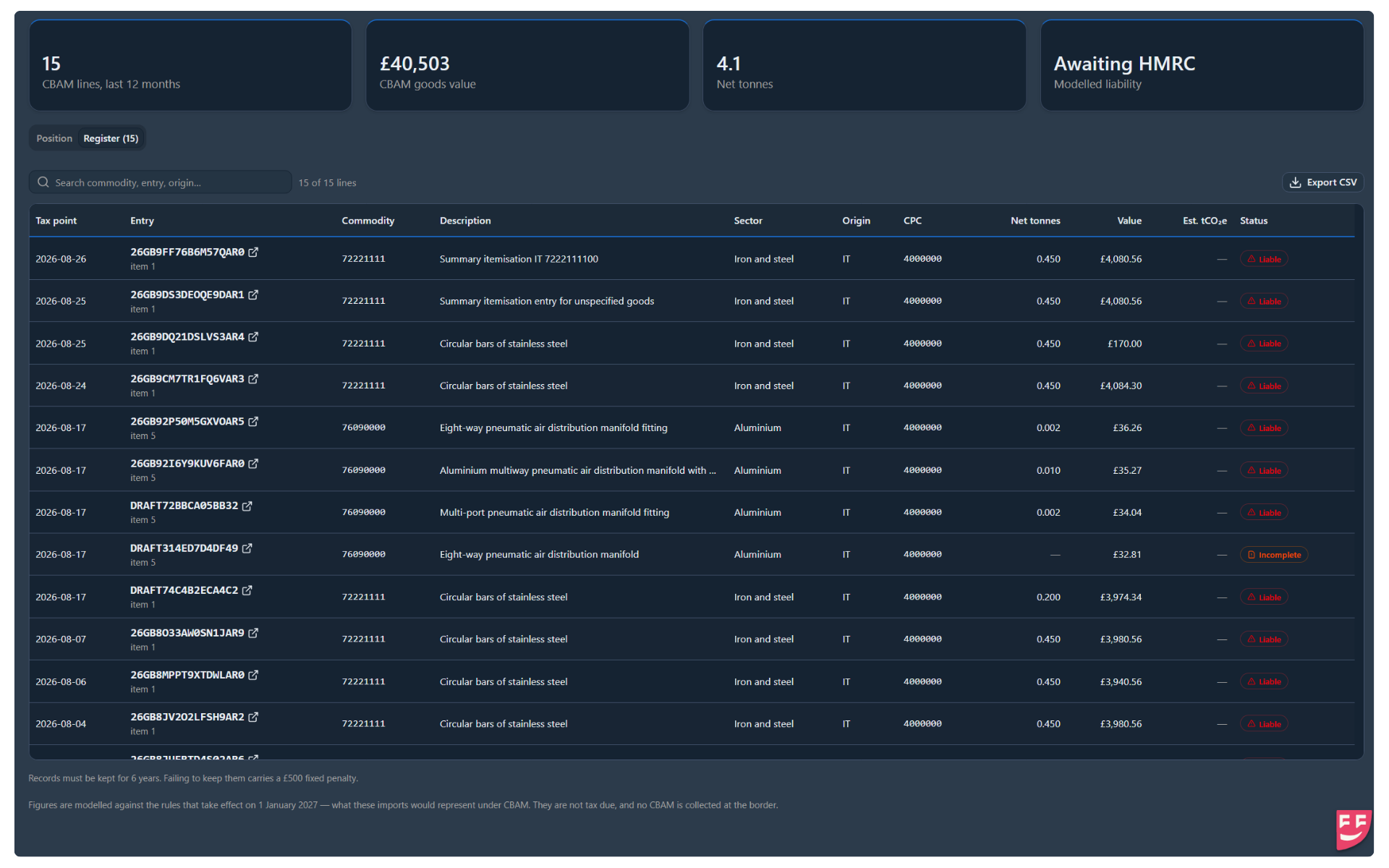
And we are honest about what nobody knows yet. iX shows no carbon cost figure, because the emissions calculation depends on a default value HMRC has not yet published. We would rather give you no number than a wrong one. The moment those values land, they drop straight into a register that is already complete.
For brokers, the same detection runs across the whole client book: which clients import CBAM goods, which are already over the line, which are approaching it, and which have records that would not survive a return. That is a reason to call every client in 2026 with something genuinely useful, rather than a pitch.
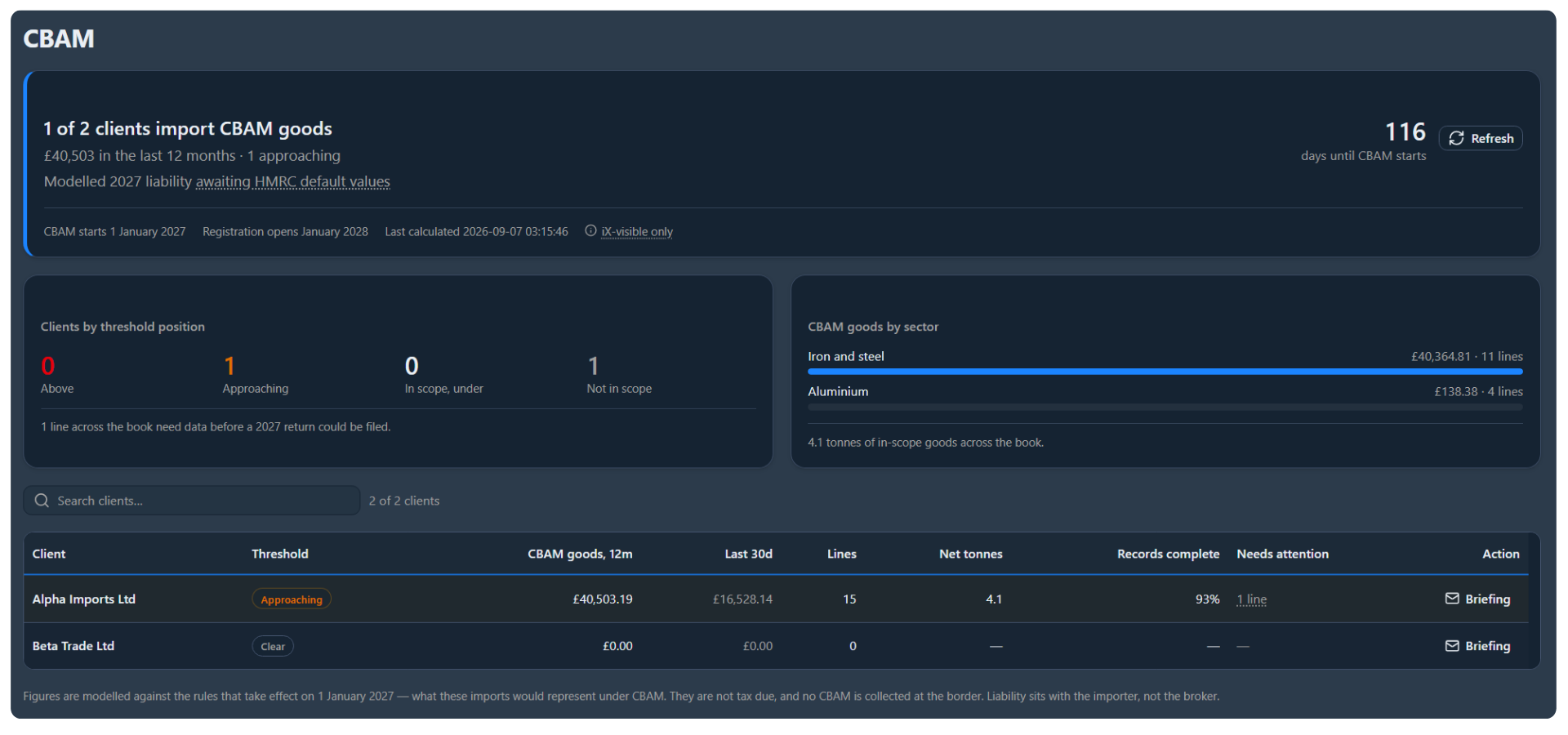
If it is useful to have the dates, thresholds and checklist above in one place rather than digging back through this post, we have put it together as a one-page CBAM readiness guide you can download and keep.
Download our Customs iX CBAM readiness guide (PDF)
Before the year is out
The honest priority list is short. Work out which imports genuinely carry CBAM exposure, and check the classification underneath that answer, not just the assumption. If you trade into the EU, get authorised as a declarant before you need to import, not after. If you trade into the UK, start tracking the £50,000 threshold tests now, since the liability accrues whether or not you have registered yet. Start supplier conversations now for real emissions data, not defaults.
The businesses that come out ahead on CBAM will not be the ones with the sharpest carbon strategy. They will be the ones who got the unglamorous part right first: the classification, the declaration, the paperwork nobody wants to own.
So, genuinely, is your CBAM exposure something you have actually worked out, or is it still sitting three items down on someone's to-do list?