

HMRC gave you the data. Not using it is now a choice.
Every UK importer and exporter can now download their own customs records from HMRC, free. Almost nobody does.
HMRC uses those same records every time it checks a business. If there are mistakes in them, "we did not know" no longer works as a defence.
What a customs declaration is
Every time goods come into or leave the UK, someone files a declaration with HMRC. Usually that is your customs broker or freight forwarder. It says what the goods are, what they are worth, where they came from and how much duty and VAT is due.
It is not just paperwork. Filing a declaration is a formal legal act. It fixes how much customs duty and import VAT your business owes, and if the details are wrong, your business is liable, even if someone else filed it. Repeated mistakes can lead to penalties, and to HMRC withdrawing simplified procedures your business relies on.
Most businesses never see these declarations. They pay the bill and trust that the broker got the details right.
What changed this year
Getting a copy of your own declarations used to mean paying for a subscription, up to £960 a year plus VAT. Most businesses decided it was not worth it.
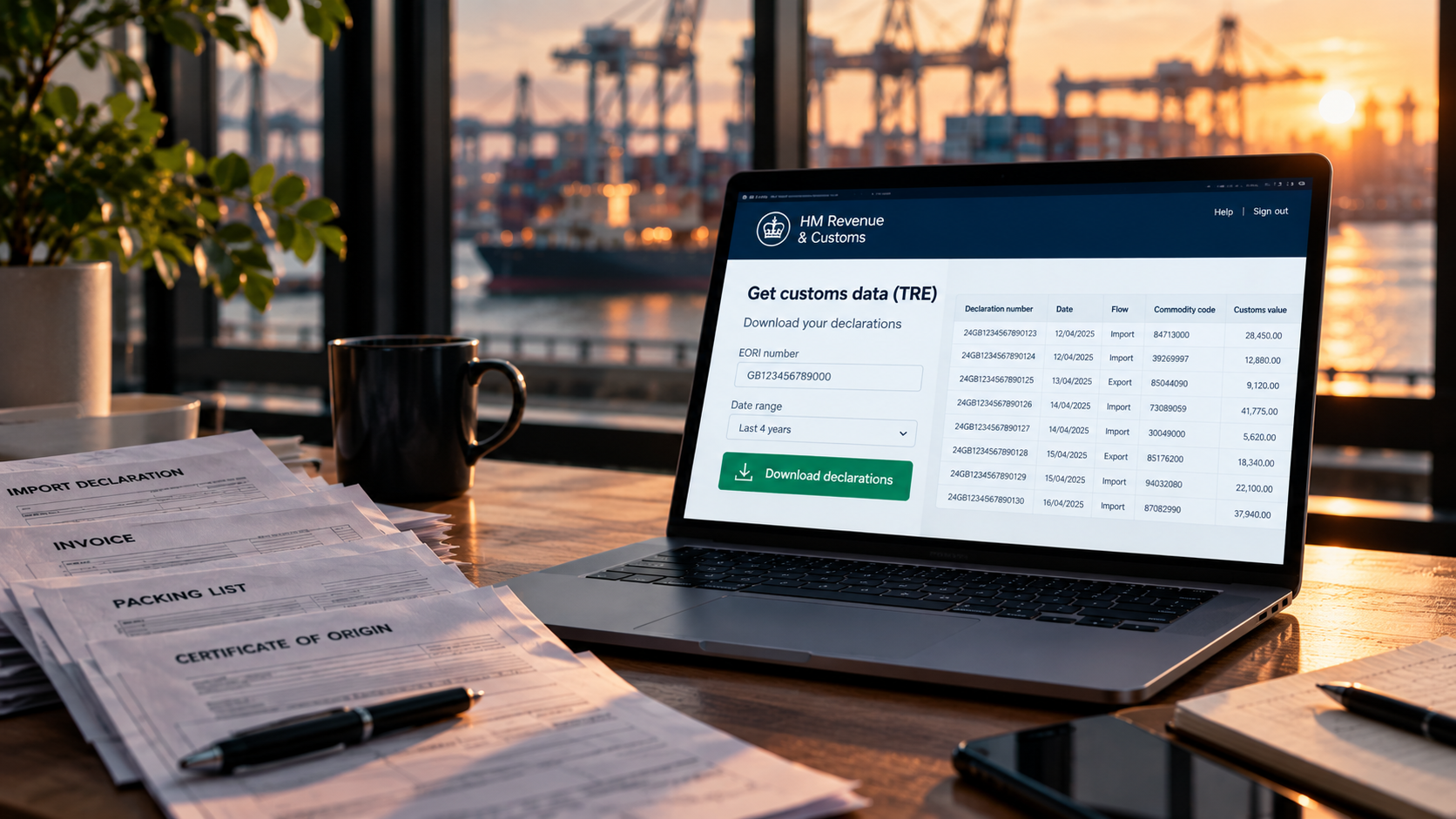
That ended on 31 March 2026. HMRC's Get customs data service, also called TRE, is now the only route, and it is free. Sign in through Government Gateway and you can download every declaration made under your EORI number for the last four years.
Around one percent of UK businesses have done it.
Why it matters to you
When HMRC checks your business, it looks at these records. Not your spreadsheets. Not what your broker says it filed. What is in HMRC's system.
Before, if HMRC found a mistake, a business could argue it had no practical way to check. The data was expensive and hard to get.
Now it is free and a few clicks away. If the mistakes were there to see, HMRC can reasonably ask why nobody looked. Not knowing has become a choice.
HMRC is also looking more often. Penalty notices to large businesses went from 124 to 627 in twelve months.
What is usually wrong
The costly mistakes are not the ones that stop goods at the border. They are the quiet ones that let goods through and repeat on every shipment.
- The wrong commodity code. Often copied from the supplier. A wrong code means the wrong duty rate, every time.
- The wrong value. Freight or insurance left out of the customs value, or counted twice.
- Savings nobody claimed. Goods that qualified for reduced or zero duty under a free trade agreement, where nobody asked for it.
- VAT paid upfront. Import VAT paid at the border that could have been postponed.
Some of these mean you paid too much. Some mean you paid too little and owe HMRC. Either way, you want to know before HMRC tells you.
Why most businesses still do not check
Downloading the data is easy. Checking it is not.
Each report covers 31 days, so a year means a stack of spreadsheets. Every line then has to be compared with the invoice, packing list and origin paperwork behind it. Most teams do not have the time, so they check a small sample and hope the rest is fine.
How Customs iX checks all of it
- Nominate us. Name Customs iX as a third party in HMRC's free service, through Government Gateway. No IT project.
- We check every declaration. Audit checks every line, not a sample, for the right code, the right value and the right origin. Felix reads your shipment documents and checks they match what was declared.
- You fix what matters. Every issue becomes a task your team can review and close. Where you overpaid duty, Audit prepares the claim file for HMRC.
Most customers see their first results within a week.
The question to ask yourself
HMRC can see every declaration made in your name. So can you, for free. If HMRC looked at your last twelve months tomorrow, would you already know what it would find?
Book a demo at customsix.co.uk/demo